Uganda is known as the Pearl of Africa, and over twelve days on this cycling safari you find out why. You travel along quiet dirt roads, past crater lakes, tea plantations, rainforest and open savannah. You stop in small villages, wave back at children by the roadside and get a glimpse of daily life away from the city. You take a boat along the Kazinga Channel and go in search of chimpanzees or mountain gorillas. There is a good chance of seeing four of the Big Five; only the rhino is missing. This is a safari in Uganda with CvA travel. The bike brings you close, and you don’t need to be an experienced cyclist to join.
You decide how much you cycle on your Uganda safari
Explore a country. Experience it along the way. The bike takes you to places you might otherwise never reach, and you decide how much you ride. Want to cycle every kilometre and every climb under your own steam? You can on this Uganda safari. Prefer to cycle a little less? Choose the e-mountain bike or ride part of the way in the support vehicle. You don’t have to be a keen cyclist, but you are welcome if you are. With 4 to 6 travellers, an experienced cycling guide and a driver, everyone in the group travels the same route in their own way. You can read how this works in practice under Practical information.
Uganda safari: your trip at a glance
You cycle on 7 of the 12 days. On the other days you travel by boat, walk, go on safari or rest. This is how your Uganda safari looks:
- Day 1: arrival in Entebbe, time to settle in by Lake Victoria
- Day 2: transfer to the Coffee Lodge at Clarke Farm
- Day 3: cycling past coffee and tea plantations to Fort Portal
- Day 4: cycling past crater lakes, then by car across the savannah of Queen Elizabeth National Park
- Day 5: free day in Queen Elizabeth: optional chimpanzee trek in the Kyambura Gorge; in the late afternoon, a game drive and a visit to the salt lakes
The route
Over twelve days, this cycling safari takes you on a tour of western Uganda. You start by Lake Victoria in Entebbe and travel via Fort Portal, the savannah of Queen Elizabeth National Park, the Bwindi rainforest and Lake Bunyonyi to Lake Mburo, before driving back to Entebbe. The map shows the full route.
From Entebbe to the Mountains of the Moon
Your Uganda safari begins at a relaxed pace in Entebbe, on the shores of Lake Victoria. The city is soon behind you. After a first introduction to Katambale Village, you head towards Fort Portal, with the Rwenzori Mountains – the ‘Mountains of the Moon’ – in view. The route passes crater lakes, tea plantations, banana and coffee fields and small villages, where you can stop for a chat or a photo.
The ‘African massage’
Most of the riding is on unpaved roads: sometimes dusty, sometimes rutted and bumpy. Our guides laughingly call it the ‘African massage’. It is part of a cycling safari in Uganda, and it takes you to places mass tourism doesn’t reach.
Cycling safari across the savannah of Queen Elizabeth National Park
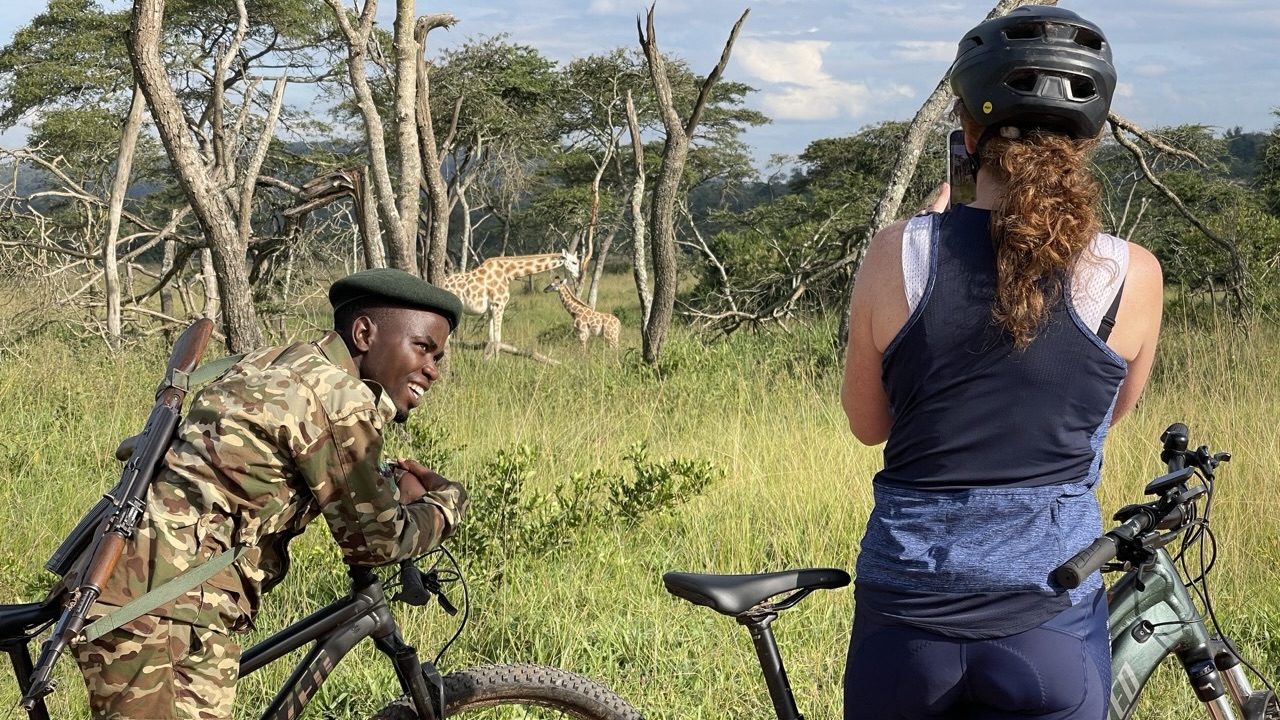
From the green hills you descend to the savannah of Queen Elizabeth National Park, home to elephants and buffalo. With luck, you will see the tree-climbing lions of the Ishasha sector. You ride as a group with your guide. Where safety requires it, a ranger joins you; we decide this on the spot before the stage begins. The support vehicle always stays close by, which makes this a true cycling safari in Uganda. Would you rather watch the wildlife from the car? Then simply ride this section in the vehicle.
The Kazinga Channel by boat
During this Uganda safari you take a boat safari along the Kazinga Channel. From the boat you see hippos and many birds. Elephants and buffalo often come down to drink at the water’s edge, and with a little luck you may spot a crocodile. Keep an eye on the water, too: frothy bubbles often give away a hippo lying just below the surface.
Chimpanzees in the Kyambura Gorge
If you wish, you can join an optional excursion to the Kyambura Gorge during your Uganda safari. This 100-metre-deep gorge is covered in tropical forest and runs from the Kichwamba Escarpment to the Kazinga Channel. With a Uganda Wildlife Authority guide, you walk into the gorge to look for chimpanzees. Black-and-white colobus monkeys, red-tailed monkeys and baboons also live here, along with many birds. There is also a chance of elephants, which wander into the gorge from the savannah.
Into the rainforest: the hills around Bwindi
After the savannah, the landscape of your Uganda safari changes. You head into the hills towards Bwindi Impenetrable National Park. Mist hangs between the trees as you ride past tea plantations and through villages. Bwindi has been a UNESCO World Heritage Site since 1994, and for good reason. The rainforest lies at an altitude of just over 1,100 to 2,600 metres and is home to around half of the world’s mountain gorillas. It also has some 120 species of mammal, including chimpanzees, elephants, colobus monkeys and red-tailed monkeys, as well as more than 350 bird species and over 200 species of butterfly. Buhoma, on the edge of the park, is its headquarters. The surrounding villages are home to communities including the Bakiga and the Batwa; the Batwa were the forest’s original inhabitants.
Optional: face to face with mountain gorillas on your Uganda safari
Day 8 is a free day in Bwindi. If you wish, you can go gorilla trekking. With experienced rangers, you walk into the rainforest in search of a family of mountain gorillas. Once you find them, you can watch them up close. A silverback walking calmly past while the young play together: it is a moment you won’t easily forget.
A night on an island in Lake Bunyonyi
After the last ride through the hills, a boat takes you to Habuharo Island in Lake Bunyonyi. The lake has 29 islands. It is a place to unwind completely during your Uganda safari.
Ending your Uganda safari among the zebras and giraffes of Lake Mburo
Your Uganda safari ends with a cycling safari in Lake Mburo National Park, one of Uganda’s smallest savannah parks, with acacia trees, wetlands and lakes. You ride with your guide and a ranger, who cycles with you for the whole ride, and the support vehicle stays close by. Along the way there is a chance of zebra, impala, eland (Africa’s largest antelope), giraffe, buffalo and warthog, and more than 300 bird species live here. From the Kazuma viewpoint you look out over the lakes and the savannah. Afterwards you drive back to Entebbe, where we drop you at the airport. If you are extending your trip, we take you to your hotel.
Meet the people of Western Uganda
A safari in Uganda is also about people. Along the way you meet the people who live here. In the villages you ride through, children wave enthusiastically. In Rwimi you stop for a drink at a local bar, where someone may well join you for a chat. In Queen Elizabeth National Park you meet a local community that lives within the park’s boundaries.
Want to know more about life in the rainforest? In Bwindi you can do the Batwa Experience, walking through the forest with Batwa guides and learning how they lived here for centuries as hunter-gatherers. On the way to Lake Mburo you pass Igongo, a cultural centre near Mbarara with traditional homes of the cattle herders and farmers of south-western Uganda.
Places to stay that suit the country
After a day on safari in Uganda, you rest in distinctive places. You stay at a lodge on the rim of a crater lake, with views of the snow-capped peaks of the Rwenzori Mountains on clear days, and at a family-run eco-lodge on the edge of the Ishasha sector of Queen Elizabeth National Park. You also spend a night at a lodge that supports women and families in Bwindi, and on an island in Lake Bunyonyi. At the end of the trip you look out over Lake Mburo National Park from a hilltop. You can read more about where you stay on your Uganda safari under the Accommodation tab.