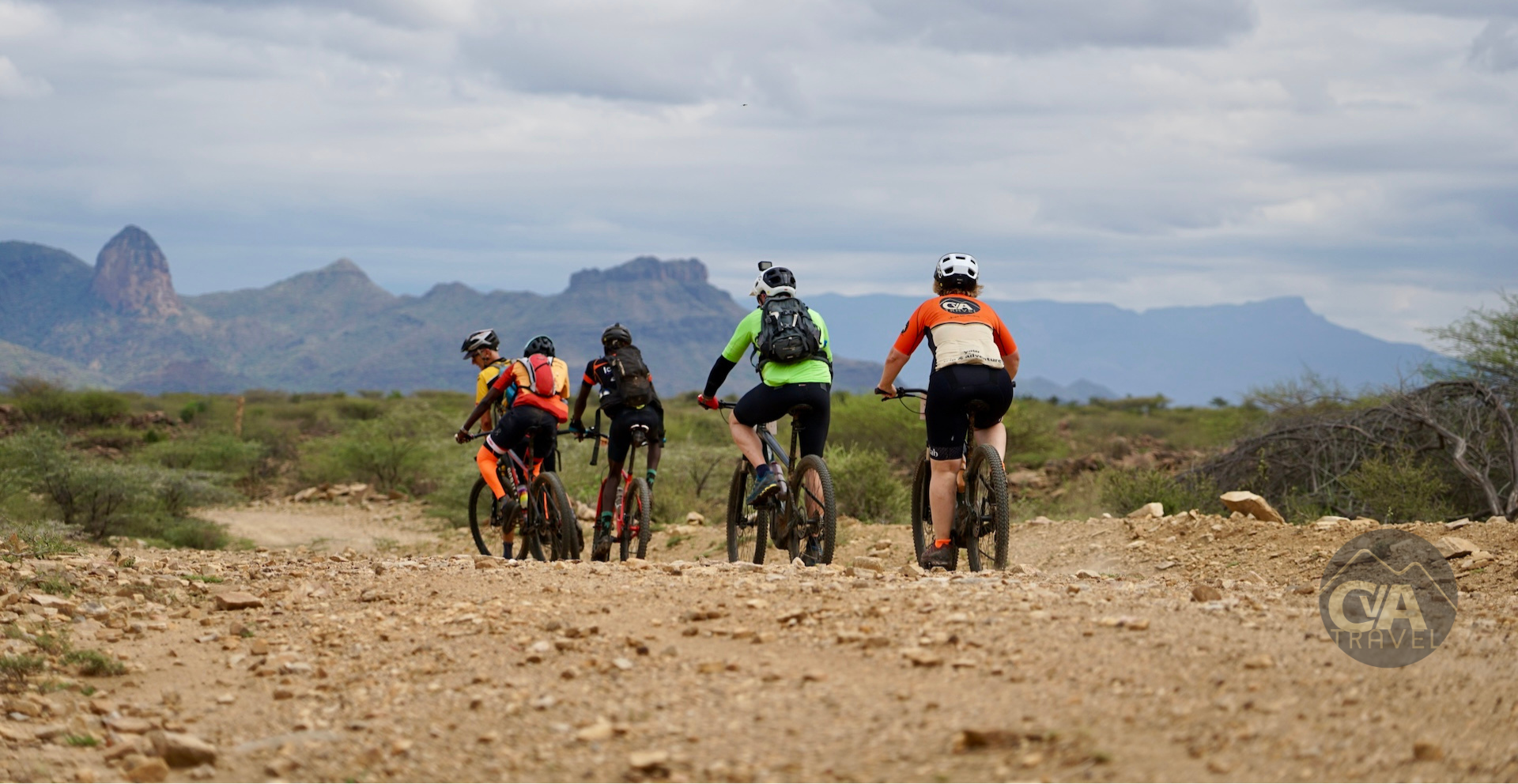
The Tour of Karamoja is Uganda’s official cycling event, created to share a positive and authentic story of the country’s north-eastern region and to encourage sustainable tourism. This extraordinary journey takes you deep into Uganda’s most remote landscapes, where vast open spaces, silence and rhythm define the ride. Along the way, your presence contributes directly to local development.
You stay in small-scale, locally run settings through ‘lazy camping’. Rather than sleeping in a room, you spend the night in a comfortable two-person tent with a proper mattress, already set up on arrival. It is a relaxed and thoughtful way of travelling, allowing you to experience the outdoors without sacrificing comfort. Throughout the journey, you engage with local communities, sharing moments and activities that offer genuine insight into everyday life, traditions and customs.
By taking part in the Tour of Karamoja, you contribute €150 to a local cause, included in the overall trip price. Together with fellow participants, you help raise funds for the Matany Girls’ Vocational School. A contribution of €550 enables one girl to complete a full vocational training programme, including an internship and career guidance — a meaningful step towards independence and opportunity.
In 2026, the Tour of Karamoja marks its 10th edition, a milestone we are celebrating with special care. For this jubilee year, up to 100 participants can join the ride, and the tour has been thoughtfully adapted to welcome a broader range of cyclists.
The route follows the Warrior Nomad Trail, beginning on the wide savannah plains of Pian Upe Wildlife Reserve. From here, you ride through the forests of West Pokot, cross the rolling landscapes of the East African Rift, and eventually reach the remote wilderness of Kidepo Valley National Park.
Of the eight stages, six are offered with two route options: a shorter alternative and a longer, full-distance ride. Each afternoon, after lunch, you decide which distance suits you best that day. This flexible approach keeps the journey demanding yet accessible, allowing space for both challenge and enjoyment.
A journey that lingers — for you, and for the people whose lives it quietly touches.
Curious to see more? Watch the video on this page for a first impression of the Tour of Karamoja.
The route you’ll cover during the Tour of Karamoja 2026
Your journey through Karamoja begins in Entebbe. From here, you travel by road to the starting point of the Tour of Karamoja in the wide, open landscapes of Pian Upe Wildlife Reserve.
From Pian Upe, you take to the bike and ride straight into the heart of Karamoja. The landscape gradually opens up as you cross arid, desert-like terrain and pass through small, remote villages. Along the way, you cross the border with Kenya twice, following routes that have long connected communities on both sides. The ride leads you through the dramatic East African Rift, where a sequence of gentle undulations and more sustained climbs is rewarded with expansive views stretching far across the land.
Your journey culminates in the remote wilderness of Kidepo Valley National Park. After completing the cycling stages, you return by road to Entebbe, where, on day 15, you board your flight home.
The route covers approximately 760 kilometres, with around 7,300 metres of elevation gain. You complete this distance over eight carefully designed stages, varying in length and difficulty, allowing each day to unfold at its own pace.
Would you like a first impression of the atmosphere? Watch the video on this page for a glimpse of the Tour of Karamoja.
Support the Cause: Matany Girls’ Vocational School
With CvA travel, the experience goes beyond adventure and cycling alone. You travel through distinctive regions and encounter local communities along the way. In Karamoja, this journey brings you close to everyday life, while the Tour of Karamoja allows you to make a meaningful contribution to an initiative rooted in the region itself.
One such initiative is the Matany Girls’ Vocational School, based in north-eastern Uganda. Here, many girls grow up facing significant challenges, including limited access to education and healthcare. Early marriage, gender-based violence and the lasting impact of conflict often restrict their opportunities — despite their potential and resilience.
The school was founded by Naduk Florence Nora, who was born and raised in Karamoja. A scholarship enabled her to pursue an education, an opportunity that shaped her life and outlook. Guided by her own experience, she chose to invest in her community, creating pathways for girls to learn a profession, gain independence and build a future with confidence.
By taking part in the Tour of Karamoja, you explore this remarkable region while contributing directly to the future of young girls. Your participation supports education, vocational training and the prospect of sustainable livelihoods — tangible steps towards long-term change.
Together with the local community, this helps create new opportunities for girls and women across Karamoja.
Will you travel with us?
Departure Dates
Uganda’s Wilderness Bike Challenge
The Tour of Karamoja is Uganda’s official cycling event. As this is a special event, participation is limited to 100 people worldwide. Interested in taking part? Check the event date below.
Curious about what the ‘fit’ level means? Check the ‘Practical Information’ tab to find out.
💡 Tip: You can always hire one of our e-mountain bikes for extra support. Please note that this must be arranged in advance, and switching bikes during the trip is not possible.
Prefer another cycling tour through the Karamoja region or a private cycling trip?
That’s possible too! CvA travel also offers 2 other small group tours (from 4 people). The 17-day northeastern tour through Uganda is the luxury alternative, which also goes through parts of the Karamoja region. Would you prefer to book a private trip? Feel free to contact us; we are happy to help you plan a tailor-made individual journey (view private trips Uganda).
Daily Itinerary
Day-to-Day Programme: 16-Day Tour of Karamoja
Below, you’ll find the full day-by-day itinerary of the Tour of Karamoja 2026. Since the event takes place in a remote and untouched area, the route may still be subject to changes. This is one of the most remarkable journeys through which you will experience the authentic and rugged landscapes of Uganda. Prepare to be amazed by the countless diverse and fascinating sceneries, the wildlife, and the warm, cheerful locals you’ll meet along the way.
Day 1: Wednesday, 28 October 2026 - Arrival in Entebbe
The cheerful atmosphere of this country greets you the moment you set foot on Ugandan soil. You’ll immediately feel you’ve entered a completely different world, but one that warmly welcomes you. You’ll be greeted with friendly smiles at customs, and afterwards, our Ugandan team will be waiting to take you to your hotel in Entebbe.
Meals: Not included
Accommodation: Avocado Bay
Day 2: Thursday, 29 October 2026 - Acclimatisation in Entebbe
Today, we take it easy to help you acclimatise after your arrival in Uganda. If you’ve brought your own bike, this is the perfect time to assemble it and prepare everything for the Tour of Karamoja, which begins tomorrow.
Discover the hectic energy of Kampala in a unique way with a local guide. Riding on the back of a boda boda (motorbike taxi), you’ll zip through the city and experience the everyday life of Uganda’s capital. During this excursion, you’ll climb the 300 steps to the Uganda National Mosque, where you’ll be rewarded with a panoramic view of Kampala. You’ll witness the striking contrast between the city’s modern and traditional areas, as well as the famous taxi park—a chaotic yet fascinating place where hundreds of minivans converge. This unforgettable experience will give you an authentic impression of Kampala!
Day 3: Friday, 30 October 2026 - Transfer to Kampala
Day 4: Saturday, 31 October 2026 - Heading to the Karamoja Region
Today, you’re off to the Karamoja region. From Kampala, it’s a long but beautiful drive to Pian Upe Wildlife Reserve. Located at the southern entrance to the Karamoja region, this is the largest protected area in Uganda. The park lies in a ‘savanna basin’, nestled between three extinct volcanoes: Mount Elgon, Mount Kadam, and Mount Napak. Pian Upe offers ideal conditions for wildlife, including giraffes, cheetahs, zebras, ostriches, and the rare Fox’s Weaver.
Activities:
In the late afternoon (depending on your arrival time at the park), you’ll take a short guided walking safari through the area, discovering the wonders of the park along the way. At the end of the walk, you’ll settle on Elephant Rock, overlooking the vast savannas. As the sky turns a stunning shade of orange from the setting sun, you’ll wrap up your first day in Karamoja with a view that’s nothing short of breathtaking.
Day 5: Sunday, 1 November 2026 - The First Cycling Kilometres
You wake up at Pian Upe Eco Camp, a campsite situated on the slopes of Mount Kadam. With your first cup of coffee in hand, you gaze out over the entire nature reserve and the peak of Mount Elgon. A magnificent start to the day. With a smile from ear to ear, you hop on your bike. Today’s first kilometres literally wind around the base of Mount Kadam. Just before lunch, you’ll face a moderately challenging climb, but at the highest point, you’ll be rewarded with a spectacular view. After lunch, the route continues along a remote gravel path passing various local communities of the Pokot tribe, known for their camel herding. The final stretch takes you along delightful single tracks through the deep Pokot forest, where you’ll have several opportunities to take a refreshing dip.
Activities:
In the evening, you’ll explore the village with a guide and visit a traditional healer named Mama Maria, who will introduce you to the customs and daily life of her community.
Accommodation:
Lazy camping in the gardens of Kayla Peace Village, run by young members of the community. This place provides them with educational opportunities and work experience. They also love to organise football matches, so there’s a good chance you’ll witness a local game!
Cycling distance: 80 km
Elevation gain: 500 m
Day 6: Monday, 2 November 2026 - Cycling from Kosike to Namakuriat
Today promises to be a day filled with adventure and cultural immersion. After enjoying the sunrise, you enthusiastically hop on your bike. Your first stop is at a traditional camel camp, where you’ll see how nomadic herders live alongside their camels and learn about taming and milking them. Afterward, you continue along some fantastic single tracks, cycling beneath thorny acacia trees, crossing various streams, and gradually approaching the Kenyan border. After lunch, you cycle downhill to the town of Namakuriat. But watch out for wandering camels!
Accommodation:
Lazy camping in the gardens of the Comboni Mission, beneath cool acacia trees and a clear, star-filled sky, far away from civilisation. This mission has established a remarkable project where the local community is trained in bread-making and other essential skills. And of course, this means freshly baked bread the next morning.
Cycling distance: 58 km
Elevation gain: 760 m
Day 7: Tuesday, 3 November 2026 - From Namakuriat to Kanton Lokiriama
After a breakfast that includes freshly baked bread, you begin with a gradual climb. As you cycle along the unpaved roads, you’ll enjoy the beautiful views stretching out before you. Upon reaching the Kenyan border, the path twists towards the dry, rugged terrain of Turkana Country. You’ll immediately notice the landscape, temperature, and humidity are entirely different from the lush greenery of previous days. The final part of today’s journey takes you through various local communities, where cheerful greetings await you around every corner. After lunch, you still have 30 kilometres of challenging terrain ahead. It’s a mix of gravel, dry river crossings, and soft sandy paths. Coupled with high temperatures, this makes for a demanding section. Yet, the surrounding unique landscapes and incredible vistas will help you forget the heat.
Activities:
You’ll visit a local community and witness a ceremony where an animal is sacrificed to wish you a safe journey. Thanks to your participation in this tour (the fundraiser) and previous tours, girls from this community have been able to attend Matany Girls’ School.
Accommodation:
Lazy camping with the community.
Cycling distance: 80 km
Elevation gain: 550 m
Day 8: Wednesday, 4 November 2026 - To Matany
You wake up to the sound of bleating goats and sunlight streaming through your window. After bidding farewell to the community, you begin a 40-kilometre cycling journey. Today, you’re heading back to the ever-green Uganda. The first 10 kilometres involve a steady climb up to the Karamoja Plateau, where you’ll cross the border once again. The path continues with a gentle slope all the way to the bustling town of Moroto. In Moroto, you’ll encounter the modern side of Karamoja and visit the Shanita Project. After this impactful stop, you’ll cycle 50 kilometres further towards Matany Girls’ School. A scenic route through local communities eventually leads you to your final destination in Matany.
Activities:
The Shanita Project provides children – from vulnerable backgrounds or orphans – with the opportunity to receive quality education. You’ll be given a tour of the school and even the chance to talk to the children. You’ll be amazed by the positive impact this project has on their lives.
Accommodation:
You’ll spend the night at a Lazy Camp in the gardens of Matany Girls’ Vocational School. The students are incredibly hospitable and enjoy having a chat. This stay offers you a wonderful opportunity to learn more about the project and connect with students, staff, and the school’s founder.
Cycling distance: 91 km
Elevation gain: 870 m
Day 9: Thursday, 5 November 2026 - Pedalling to Abim
Prepare for a long day of cycling! You’ll set off early to cover as much ground as possible during the cooler hours. As you cycle, you’ll pass through open landscapes where the wind can occasionally be a real challenge. Eventually, you’ll reach the Bokora Wildlife Reserve – a park known for its diverse bird species, including ostriches. If you’re lucky, you might even spot one. During the last 40 kilometres, the landscape gradually transforms as you enter the lush Abim District, a hidden gem located on the western side of the Karamoja region. Abim is renowned for its breathtaking scenery of green hills and striking rock formations – a view you won’t find anywhere else in Uganda.
Activities:
After arriving, you can take a scenic walk through the area, enjoying stunning views of green hills and impressive rock formations. And don’t miss the sunset – we promise it will be one of the most beautiful and colourful sunsets you’ll ever see.
Accommodation:
Lazy Camp
Cycling distance: 104 km
Elevation gain: 310 m
Day 10: Friday, 6 November 2026 - Heading to Nakapalimoru
Today, you’ll cycle the first 50 kilometres over picturesque hills and pass through various villages. You’ll ride along fields where peanuts and sesame are grown. After lunch, the route continues over unpaved roads, taking you through several African villages until you reach Nakapalimoru – the largest traditional village in East Africa. A unique feature of this village is “The Leader”, a large granite rock said to possess special powers.
Activities:
Upon arrival, a local guide will lead you on a walk to learn more about “The Leader” and the local community.
Accommodation:
Lazy Camp: The camp is located in the heart of the village, inhabited by the Jie community. The people live in grass-thatched huts and have preserved their traditional culture. Staying here offers you a unique chance to experience the authentic life of this community.
Cycling distance: 115 km
Elevation gain: 600 m
Day 11: Saturday, 7 November 2026 - Cycling to Kaabong
After a warm farewell from the community, you set off on an 80-kilometre ride. Today’s landscape is unlike anything you’ve seen so far. Following undulating gravel roads, you’ll enjoy spectacular views of rugged mountain peaks rising above the forests. Just before reaching the highest point of the day, you’ll cross an old migration corridor for elephants and buffaloes before beginning the final stretch of the day. This last section is the most beautiful part of the entire tour. You’ll zoom past immense, massive rock formations on a 40-kilometre descent, followed by a short climb to reach your destination, Kaabong.
Accommodation:
Lazy camping in the gardens of Kaabong Resort. You’ll have a magnificent view over the landscape of Kaabong. We can confidently say: it’s pure bliss.
Cycling distance: 80 km
Elevation gain: 690 m
Day 12: Sunday, 8 November 2026 - To Kidepo Valley National Park
When you wake up, you’ll immediately feel the difference of being at a higher altitude – a refreshing change from previous days. After a hearty breakfast, you’ll set off towards Kidepo Valley National Park. Today’s route is varied and challenging, designed to put your cycling skills to the test. You’ll start by cycling 20 kilometres along well-paved gravel roads through Kaabong, before reaching the rugged Morungole mountain range. The next stretch involves a challenging 20-kilometre climb along single tracks, ascending approximately 900 metres to the East African Rift escarpment, which sits at 2,000 metres above sea level. As you pedal upwards, you’ll be rewarded with the most breathtaking views of your journey so far. Along the way, you’ll visit the Ik community, one of Uganda’s smallest traditional tribes, offering you a rare insight into their unique way of life. The descent is just as thrilling – a 30-kilometre ride down single tracks, passing communal gardens and encountering the occasional tsetse fly before you reach the entrance to the park. If needed, a transfer is available.
Activities:
Upon arrival, take a short walk to the villages of the unique community surrounding this national park.
Accommodation:
Lazy camping at the Nagusokopire campsite in the southern part of Kidepo Valley National Park.
Cycling distance: 96 km
Elevation gain: 860 m
Day 13: Monday, 9 November 2026 - Cycling Safari in Kidepo Valley National Park
Today, you’ll set off on an unforgettable cycling safari through Kidepo Valley National Park. On a bike? Yes, on a bike! Feel the adrenaline surge as you find yourself just metres away from giraffes, elephants, buffaloes, and, if you’re lucky, even lions or cheetahs! Of course, your safety is a priority – the entire adventure is guided by rangers with a support vehicle always nearby. In the evening, you’ll gather for a special farewell dinner to celebrate your incredible journey.
Accommodation:
Lazy camping at the Nagusokopire campsite.
Cycling distance: 35 km
Elevation gain: 100 m
Day 14: Tuesday, 10 November 2026 - The End is in Sight, Return to Entebbe
And just like that, the end is in sight. The Tour of Karamoja, which led you through the heart of the Karamoja region, has come to an end.
You have two options for your transfer to Kampala:
• Flight option: Fly back to Kampala on a small plane (2 hours).
• Road option: Travel by car, which also transports the bicycles (8 hours).
Once you arrive in Kampala, a transfer will be arranged to take you to Pineapple Guesthouse in Entebbe. Here, you can freshen up, relax, and wait for your bicycle to arrive, allowing you to pack it before your late-night flight home. Our team will then take you to the airport for your journey back home.
We’re certain you’ll look back on this incredible adventure with joy and satisfaction. You’ve experienced the authentic, rugged, and wild Uganda, and contributed to various communities and children throughout the region. An experience to be proud of – and one you will never forget.
Meals: Breakfast
**Optional Extension**
If you prefer to fly home the next day, this can be arranged at an additional cost. This extension also makes it possible to enjoy the optional excursion: Kampala Experience.
Day 15: Wednesday, 11 November 2026 - Rest day + flight home
Day 16: Thursday, 12 November 2026 - Arriving home
Pricing
Pricing
Are you as excited about this Ugandan adventure as we are? Check below to see what’s included in the price.
Included:
Accommodation throughout in twin rooms or tents; solo travellers stay in their own tent.
All meals from day 2 through to breakfast on day 15, with the exception of lunch on days 2, 3 and 15.
Local transport and luggage support throughout the journey.
Transfers to and from the airport on arrival and departure.
Entrance fees to all national parks visited.
Support from a dedicated first-aid and medical team.
Snacks, drinking water and fresh fruit provided during the cycling days.
Please note: During the event, each person is allowed only one bag weighing up to 25 kg. Suitcases are not permitted.
A €150 contribution supporting the girls of Karamoja
Excluded:
International flights.
Bicycle transport on the international flight.
Travel and cancellation insurance.
Lunch on days 2, 3 and 15
Personal expenses.
Alcoholic beverages and drinks during meals.
Rental of a Specialized mountain bike and helmet (€400) (see ‘Our bikes’ under the ‘About us’ tab for detailed information).
Rental of a Specialized e-mountain bike and helmet (€550) (see ‘Our bikes’ under the ‘About us’ tab for detailed information).
East Africa visa, to be applied for online.
Massage service: $15.00 per session or $100.00 for the full event.
Optional gratuities for guides.
Accommodation
Accommodation During the “Tour of Karamoja”
Every night of the event, you will stay at a different location, supporting and promoting local businesses along the route. What makes this event truly special is the concept of “lazy camping.”
Our accommodation choices are designed to provide long-term support to local communities. CvA Travel is committed to sustainable tourism. By staying at these sites, we contribute to employment opportunities within the regions we visit. Tourism enterprises in these areas are playing an increasingly important role in boosting the local economy.
Lazy Camping
Lazy camping offers the comfort of camping without the hassle. You won’t have to pitch your own tent or prepare your own meals. Instead, you’ll sleep in spacious canvas dome tents with large windows and real mattresses, allowing you to fully appreciate your surroundings. Spending the night in the heart of the wilderness makes these stays truly memorable. Every camp is well-equipped with toilets and showers, meticulously maintained so you can enjoy your event worry-free.
What to Bring:
• Pillow
• Sleeping bag
• Towel
• Toiletries
Kalya Peace Village
Kalya Peace Village is run by young people from the community, providing them with valuable training and employment opportunities. If you enjoy football, this might become your favourite accommodation. The young organisers often host local matches, and if you’re lucky, you might even witness a game against teams from neighbouring communities. Lazy camping in the gardens of Kalya Peace Village.
Comboni-mission Namakuriat
This camp offers an authentic African experience through lazy camping. As the sun sets, gather around the campfire under the acacia trees, sharing stories with fellow travellers. Located far from civilisation, you’ll be treated to crystal-clear, star-filled skies – a truly unforgettable experience.
Traditional Village Homestay
Experience lazy camping with the local community in the largest traditional village in East Africa.
Lazy Camping at Kidepo
Experience lazy camping at the Nagusokopire Campsite, nestled in the southern part of Kidepo Valley National Park. From this serene spot, you can enjoy breathtaking views of the vast Narus Valley, the dramatic Mount Morungole, and even the distant mountain ranges of South Sudan.
Useful Information
Fitness Level for the Tour of Karamoja
We rate the fitness level of this tour as ‘Fit’, indicated by four dots. This is a challenging event with a considerable distance to cover. The terrain can be demanding, and certain sections of the route are especially hot. If you’re unsure about your fitness level, you can always rent an E-MTB from us to make the tour significantly easier.
Practical Information
Good preparation is half the battle. To ensure you’re fully ready for your cycling and group trip through Uganda, take a look at the list below. It includes essential items you shouldn’t leave behind and important details about suitable clothing. Since temperatures in Uganda are generally warm, we mostly cycle in light clothing.
Let the adventure begin!
Before Your Trip:
* Camping Essentials: Pillow, sleeping bag, towel, and toiletries (for lazy camping).
* Luggage Allowance: Only one sealed bag is permitted during the trip, with a maximum weight of 25 kg.
* Bicycle Requirement: An MTB with tubeless tyres is mandatory. Without them, participation is not allowed.
* Spare Tyres: Bring spare tyres for emergencies.
* Latex Sealant: 100 ml of latex for tyre maintenance.
* Emergency Inner Tubes: Bring spare inner tubes for emergencies.
* Puncture Plugs: Essential for quick tyre repairs.
* Brake Pads: Two complete sets of brake pads.
* Brake Cables: Two spare brake cables.
* Spare Chain: Always bring an extra chain.
* Chain Wax: For optimal chain performance.
* Gear Cable: One gear cable with a metal stop and cap.
* Windbreaker: Short-sleeved windbreaker for unpredictable weather.
* Rain Jacket: A waterproof jacket for rain protection.
* GPS Device: For navigation assistance.
* Arm and Leg Warmers: For added warmth when needed.
* Helmet: Not required if renting our MTB / E-MTB.
* Cycling Shoes: Sturdy shoes with good grip (no clipless pedal shoes).
* Cycling Gloves: For comfort and protection.
* Cycling Shorts: Essential for longer rides.
* Buff or Neck Warmer: To keep you warm and protect from dust.
* Insect Repellent: Highly recommended for protection against insects.
* Cycling Jerseys: Lightweight and breathable clothing for optimal comfort.
* Sunglasses: For eye protection from the sun and dust.
* Sunscreen: Minimum SPF 50 for high-level protection.
* Hydration Gear: Water bottles or a Camelbak.
* Swimwear: For swimming opportunities along the route.
* Evening Clothing: Lightweight, long-sleeved clothing for cooler nights and mosquito protection.
* Headwear: Hat or cap for sun protection.
* Chargers & Batteries: Ensure you have backups for essential devices.
* Headlamp: For visibility during night-time activities.
* Quick-Dry Towel: Compact and convenient for travel.
Optional / Personal Items:
* Medication: Bring any necessary personal medication.
* Saddle and Pedals: If you prefer using your own.
Itching to set off on an extraordinary ride? Can’t wait to hop on the saddle and explore your dream destination at your own pace? Take a look at all our cycling journeys below – or get in touch to request a tailor-made adventure designed just for you.